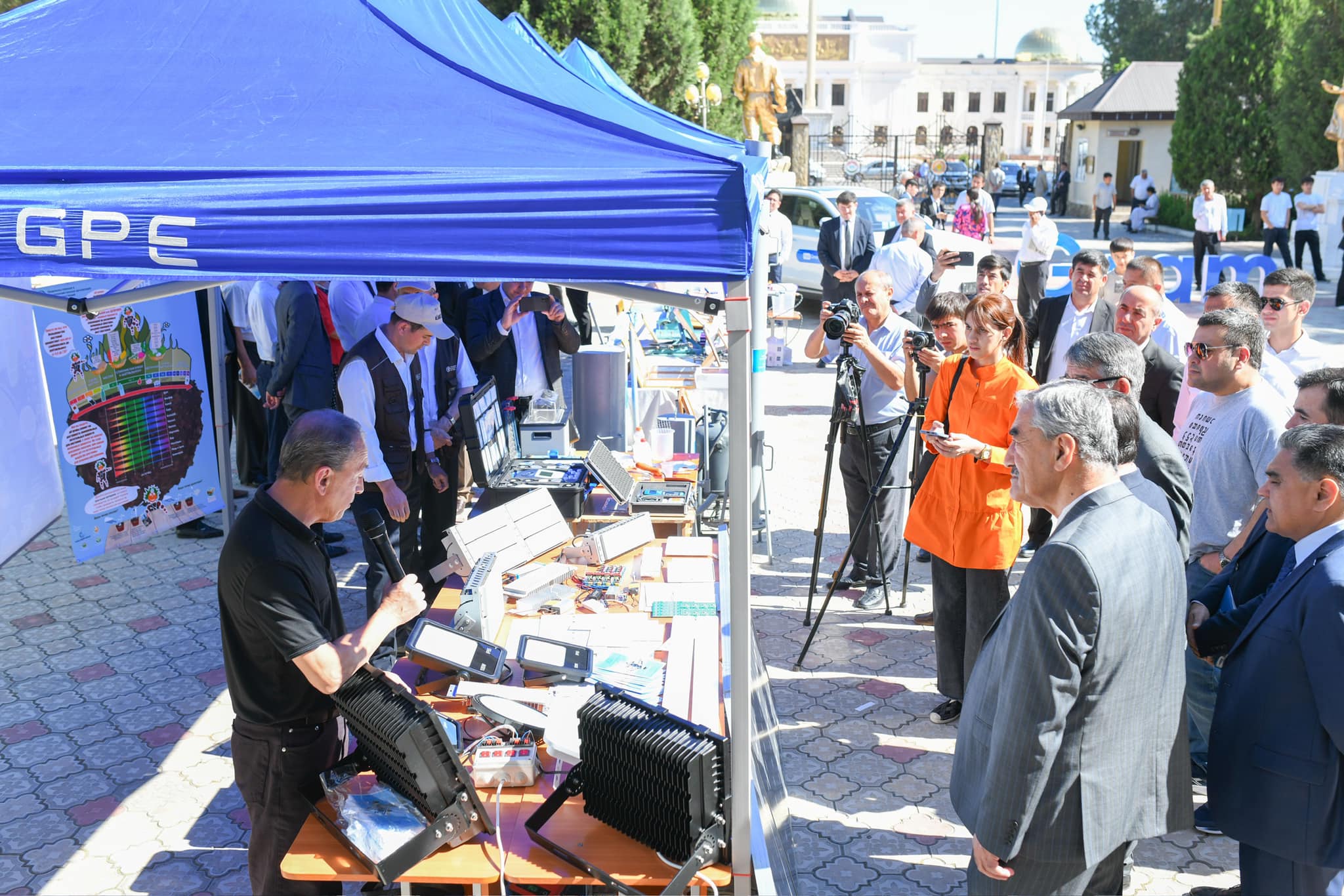
The first and already promising to become an annual festival “SUGD - CLIMATE - FEST” took place on May 31, 2024 in the city of Buston, Sughd region, as part of the regional project “Climate Change and Sustainability in Central Asia”.
The event was attended by representatives from the State Administration of State Institutions in the Sughd region, as well as officials from cities and districts, institutions focused on urban and district improvement, agricultural farms, construction companies, development partners, scientists, journalists, and environmental activists. In total, more than 150 people participated.
The primary objective of the festival was to enhance understanding and raise awareness at the regional level among decision-makers and key stakeholders regarding climate risks and existing adaptation measures.
As part of the festival, a conference was held, led by Professor Zafar Razykov, a Doctor of Technical Sciences from GMIT. The following speakers addressed the festival participants with welcoming words:
It was emphasized that Tajikistan ranks high on the Climate Change Vulnerability Index in Europe and Central Asia, yet it faces challenges in adapting to projected climate change impacts. Despite its minimal contribution to greenhouse gas emissions, the country is highly exposed to climate risks and has relatively low adaptive capacity. Specifically:
Thousands of people in Tajikistan are already experiencing the consequences of these changes, including more frequent natural disasters, shifts in growing seasons, altered precipitation patterns, late frosts, heatwaves, and associated crop losses. As the population grows, the demand for natural resources such as water, pastures, and farmland increases, further complicating adaptation efforts and community sustainability.
To address these challenges, the United Nations Development Program is implementing the Regional Project “Climate Change and Sustainable Development in Central Asia.” This project encompasses educational, practical, informational, and research activities.
Additionally, as part of the festival, an exhibition showcased resource-saving goods and services from local trading companies and manufacturers. Visitors had the opportunity to explore technologies related to renewable energy sources, various insulation methods, drip irrigation modules, drought-resistant crop varieties, complex mineral fertilizers, portable soil analysis laboratories, energy-efficient household appliances, lighting equipment, greenhouses, solar panels, and even electric cars.
The primary objective of the festival was to enhance understanding and raise awareness at the regional level among decision-makers and key stakeholders regarding climate risks and existing adaptation measures.
As part of the festival, a conference was held, led by Professor Zafar Razykov, a Doctor of Technical Sciences from GMIT. The following speakers addressed the festival participants with welcoming words:
- Rajabzoda Muhammadjobir, representative of the IOGV in the Sughd region.
- Professor Mahmadali Bakhtiyor Nabi, Rector of the Mining and Metallurgical Institute of Tajikistan, holding a Doctorate in Economic Sciences.
- Jamilya Mirsaidova, Head of the UNDP office in Khujand.
- Saidov Khurshed, Chief Specialist of the Main Department of Environmental Protection in the Sughd region.
It was emphasized that Tajikistan ranks high on the Climate Change Vulnerability Index in Europe and Central Asia, yet it faces challenges in adapting to projected climate change impacts. Despite its minimal contribution to greenhouse gas emissions, the country is highly exposed to climate risks and has relatively low adaptive capacity. Specifically:
- Extreme weather events, changes in precipitation patterns, and intensifying droughts are already affecting Tajikistan.
- These impacts place additional pressure on natural resources, making rural communities more vulnerable.
- While climate change rarely leads to direct security threats, it interacts with existing stressors, including socioeconomic, political, and natural disasters, thereby increasing social risks.
- Environmental degradation poses a hindrance to achieving sustainable development goals.
Thousands of people in Tajikistan are already experiencing the consequences of these changes, including more frequent natural disasters, shifts in growing seasons, altered precipitation patterns, late frosts, heatwaves, and associated crop losses. As the population grows, the demand for natural resources such as water, pastures, and farmland increases, further complicating adaptation efforts and community sustainability.
To address these challenges, the United Nations Development Program is implementing the Regional Project “Climate Change and Sustainable Development in Central Asia.” This project encompasses educational, practical, informational, and research activities.
Additionally, as part of the festival, an exhibition showcased resource-saving goods and services from local trading companies and manufacturers. Visitors had the opportunity to explore technologies related to renewable energy sources, various insulation methods, drip irrigation modules, drought-resistant crop varieties, complex mineral fertilizers, portable soil analysis laboratories, energy-efficient household appliances, lighting equipment, greenhouses, solar panels, and even electric cars.
To promote adaptation to climate change and reduce the risks of natural disasters, the United Nations Development Program (UNDP) is implementing the Regional Project “Climate Change and Sustainable Development in Central Asia.” Within the framework of this project, educational, practical, informational, and research activities are carried out.
As part of the festival, an exhibition featuring resource-saving goods and services from local trading companies and manufacturers was organized and held. The exhibition showcased our own products and services, technologies related to renewable energy sources, various insulation methods, drip irrigation modules, drought-resistant and high-yield crop varieties, complex mineral fertilizers, portable soil analysis laboratories, highly efficient and affordable household appliances, lighting equipment, different types of greenhouses, solar panels, and even electric cars.
During the conference, Candidate of Chemical Sciences Abduvaliev Askar discussed the fundamental concepts of climate change, its causes, and potential consequences. Additionally:
In the second part of the conference, held in the hall of the scientific council at the Mining and Metallurgical Institute of Tajikistan, the results of the competition for practical projects on adaptation to climate change and rational environmental management were summarized.
As part of the festival, an exhibition featuring resource-saving goods and services from local trading companies and manufacturers was organized and held. The exhibition showcased our own products and services, technologies related to renewable energy sources, various insulation methods, drip irrigation modules, drought-resistant and high-yield crop varieties, complex mineral fertilizers, portable soil analysis laboratories, highly efficient and affordable household appliances, lighting equipment, different types of greenhouses, solar panels, and even electric cars.
During the conference, Candidate of Chemical Sciences Abduvaliev Askar discussed the fundamental concepts of climate change, its causes, and potential consequences. Additionally:
- Director Khomitov Abduvali from the Sughd Regional Meteorological Service prepared a review of climate risks and their impact at the community level in the Tajik part of the Fergana Valley, specifically for the festival.
- Mamadov Ikromjon, Director of the Public Organization “Youth Group for Environmental Protection,” emphasized the importance of raising awareness and enhancing the population’s capacity to integrate adaptation measures related to climate change.
- Assistant Nazarova Makhinakhon from the Department of Ecology spoke about the training of necessary specialists (ecologists) at GMIT.
In the second part of the conference, held in the hall of the scientific council at the Mining and Metallurgical Institute of Tajikistan, the results of the competition for practical projects on adaptation to climate change and rational environmental management were summarized.
A total of 22 applications were submitted to the festival organizing committee, from which a competent jury selected the 10 best. These outstanding projects received prizes from the organizing committee. Among them, the 4 best projects, presented by young scientists and specialists under the age of 35, were recognized as winners of the competition. This prestigious honor was bestowed upon the following individuals:
All of these remarkable individuals received valuable prizes in the form of tablets.
Participants and guests highly appreciated the festival, describing it as a successful and beneficial project. They expressed hope that it would become a traditional and annual event. Nurbibi Boboeva, a journalist from the Sogdiyskaya Pravda newspaper, shared her perspective: “By attending an event like today’s, even a person completely unaware of environmental issues can gain necessary knowledge and apply it in practical life. Today’s festival made me contemplate the future of our planet and, most importantly, consider what I personally can do to adapt to climate change.”
Jamilya Mirsaidova, Head of the UNDP office in Khujand, emphasized that UNDP is committed to conducting effective activities aimed at raising public awareness about climate change and promoting adaptation measures. The organization stands ready to support such endeavors.
The festival was organized by the United Nations Development Program (UNDP) with financial support from the European Union. It was held in collaboration with the Executive body of state power in the Sughd region and the Main Department of Environmental Protection of the Sughd region. Partners included the Mining and Metallurgical Institute of Tajikistan, the public organization “Youth Group for Environmental Protection,” and several commercial entities from the region and the republic.
We extend our heartfelt gratitude to all partners for their invaluable assistance in organizing and hosting this remarkable festival! 🌿🌎
- Burkhonzoda Somon (KhSU, named after Academician Bobojon Gafurov)
- Shodmonova Zebo (Polytechnic Institute of Khujand)
- Shafiev Aminjon (Technopark, TSUPBP)
- Pochoev Anushervon (GMIT)
All of these remarkable individuals received valuable prizes in the form of tablets.
Participants and guests highly appreciated the festival, describing it as a successful and beneficial project. They expressed hope that it would become a traditional and annual event. Nurbibi Boboeva, a journalist from the Sogdiyskaya Pravda newspaper, shared her perspective: “By attending an event like today’s, even a person completely unaware of environmental issues can gain necessary knowledge and apply it in practical life. Today’s festival made me contemplate the future of our planet and, most importantly, consider what I personally can do to adapt to climate change.”
Jamilya Mirsaidova, Head of the UNDP office in Khujand, emphasized that UNDP is committed to conducting effective activities aimed at raising public awareness about climate change and promoting adaptation measures. The organization stands ready to support such endeavors.
The festival was organized by the United Nations Development Program (UNDP) with financial support from the European Union. It was held in collaboration with the Executive body of state power in the Sughd region and the Main Department of Environmental Protection of the Sughd region. Partners included the Mining and Metallurgical Institute of Tajikistan, the public organization “Youth Group for Environmental Protection,” and several commercial entities from the region and the republic.
We extend our heartfelt gratitude to all partners for their invaluable assistance in organizing and hosting this remarkable festival! 🌿🌎